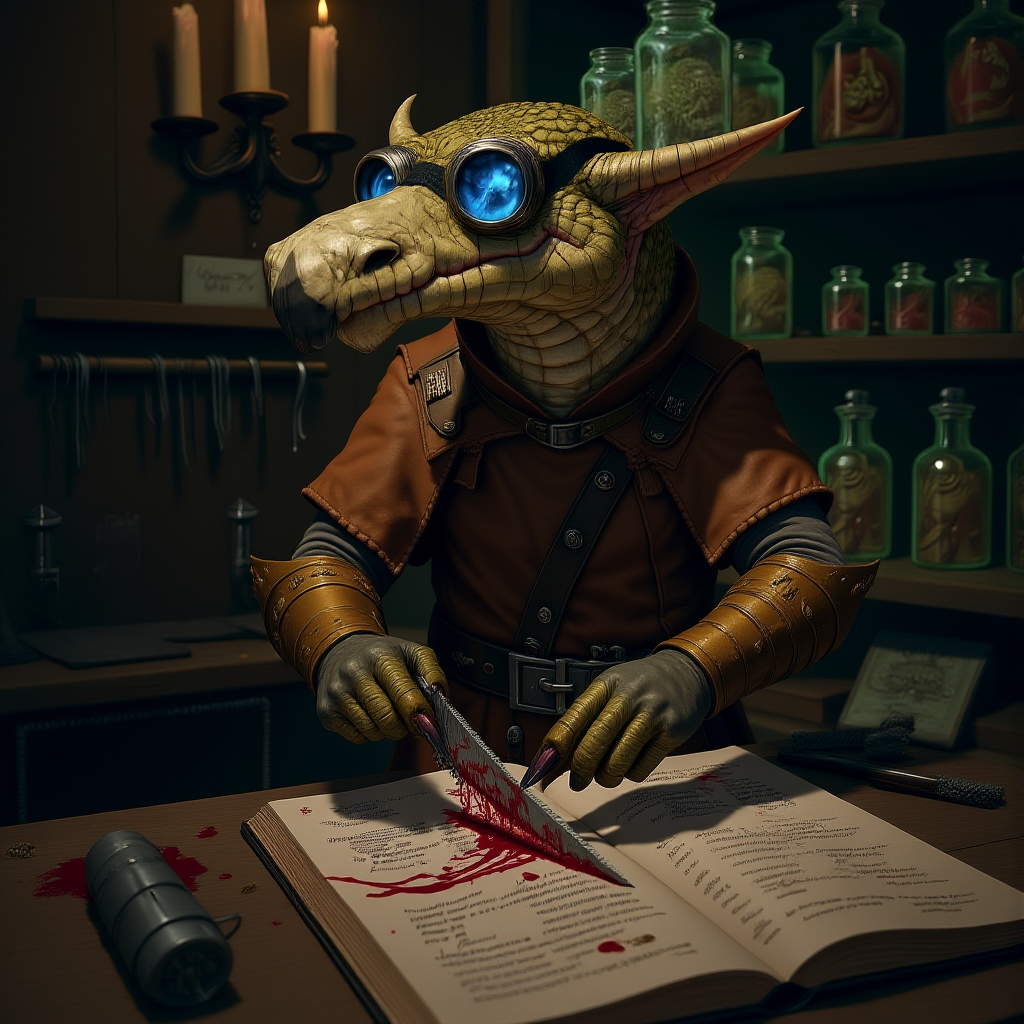
Long did the Adeptus Literaris seek to research the strange draconids that lived in the deep caves of Pyraxis. Their ability to thrive in an environment with little to no food or water, and in temperatures that left even dwarves uneasy was… fascinating.
The Quorum, led by High Councillor Voll Thebrus, acquired a batch of eggs from a clutch and had them smuggled into Linsburg. The shipment contained twelve eggs, taken from a recent raid on the Kobold cave system. Strix’s egg was slightly cracked and deemed unviable.
Starting on 01/03/1727, a total of eight eggs hatched during the following week, most with deformities. It was determined that the eggs required far greater heat than initially assumed. The remaining seven were placed beside the furnace that heated the royal palace’s bathwater. Surprisingly, Strix’s egg healed its crack after a day near the fire.
The other kobolds, except Strix, hatched over the next several days. The small creatures were vicious, eating everything within reach, their own shells, the bedding straw, the wooden crates that confined them, even bits of iron from the measuring tools. One night, two were found dead, devoured by their siblings. For safety, each survivor was placed in its own steel enclosure.
Strix was born five days later. He was missing an arm and an eye, frail but fiercely determined to live. With all specimens accounted for, the experiments began.
The Quorum pursued its studies with unrestrained ambition and no trace of empathy. Every discovery was hailed as a triumph of intellect over nature; every failure, a mere statistic.
Their first goal was to test environmental tolerance. The kobolds were exposed to extreme temperatures, from the frozen chambers beneath the palace to the blazing furnaces of the metallurgic district. Those that survived were recorded as “viable prototypes”. Those that did not were dissected to “trace failure patterns”.
Their next focus was dietary adaptability. Substances of every kind were introduced, oils, metals, wood, and stone, and their effects on growth, behaviour, and external reaction were meticulously documented.
Pain thresholds followed. The Quorum designed elaborate tests to measure reaction, recovery, and endurance, claiming to be “mapping the boundaries of sentience”. Half the subjects perished in the process.
Finally came the graft experiments. The Quorum noted the remarkable regenerative properties of kobold tissue and sought to test a long-theorized concept: the rate at which a subject would reject transplanted flesh and organs from others of its kind. Successful transplantation, they reasoned, could one day save dozens of real, important humanoid lives.
The results were brutal. Most subjects succumbed to high fevers as their bodies rejected the grafts. Strix, however, survived the transplant of an eye from a recently deceased sibling.
To the astonishment of the Quorum, Strix began speaking coherent sentences within a week. By the end of a month, he was proposing experiments of his own, more deranged than those of his keepers, and insisted on volunteering as a test subject. Among them was a successful arm transplant.
Voll Thebrus became fascinated. He petitioned High Inquisitor Seraphine to grant Strix a special dispensation for citizenship and entry into the Quorum under his supervision, arguing that the creature’s exotic intellect could expand the Empire’s understanding of natural law beyond the limits of human imagination.
Strix’s admission into the Quorum was seen by many as a political stunt, a grotesque symbol of the Empire’s domination over nature. Yet within months, scepticism gave way to awe. His precision, moral detachment, and intuitive grasp of living systems made him indispensable. Where others hesitated at ethical lines, Strix saw inefficiency.
His fascination soon turned toward the origin of magical ability, the unseen divide between those who could wield arcane power and those who could not. Where others saw an inherited spiritual connection, Strix identified a source: a connection to the Warp, the seething dimension of raw arcane potential. He postulated that this connection was not spiritual, but a tangible link anchored in the subject’s mind.
Subjects from across the Empire, natural born sorcerers, pact bound warlocks, and fallen clerics, were brought to his laboratories. Strix sought the anatomical anchor point for the Warp connection: scouring neural pathways for the “conduit” that allowed the Warp’s energy to flow into a mortal vessel. He concluded that this connection was a resonance, a dissonant frequency imposed upon the flesh that could, in theory, be surgically induced or severed.
What followed was nearly half a decade of sanctioned atrocities disguised as progress. Strix tested his hypothesis with terrifying ingenuity, using alchemical catalysts, resonant frequencies, and invasive surgery to force open a conduit to the Warp in mundane subjects. Most experiments ended in silent, brain-dead catatonia or violent physical mutation. A few resulted in unstable, raw bursts of power that twisted the subject into a screaming vortex of chaos before consuming them. Strix catalogued these as successful failures, necessary data points in the search of progress.
To the Inquisition, his work was invaluable. It promised a method to create loyal, manufactured magi and, more importantly, a final solution to permanently sever the Warp connection of any rogue sorcerer, rendering them inert.
Within a year of publishing his first results, Strix was elevated to Inquisitor, his methods classified under the codename Arcanum Vivis. His composure was immaculate, his speech precise, his reasoning impeccable. Yet behind that calm voice burned a relentless fire.
Voll Thebrus called him “the child of fire who learned to dissect the flame.
Voll’s legacy seemed unshakable until Strix uncovered fragments of correspondence between the High Councillor and Arlendari agents. The letters spoke of guilt, of plans to dismantle the Empire from within, of restoring what Voll called the “natural order”.
Strix did not hesitate. There was no conflict, no sentiment for the man who had raised him from experiment to intellect. The interrogation lasted less than an hour. When the guards entered at Strix’s request, they found a handwritten confession beside Voll’s lifeless body.
Strix personally drafted the Inquisitorial decree erasing his mentor’s name from all Imperial records, branding him a traitor.
When asked later whether he felt remorse, Strix answered:
“The Empire is the crucible that forged me. It is the only source of truth, the only valid hypothesis. All else is contamination to be sterilized.”
For this act of unwavering loyalty, Strix was promoted to Councillor of the Inquisitorial Guard of Purity.
For the next year, Strix pursued his research with relentless intensity, culminating in the singular success of the Magus Ex Nihilo project, through which he unlocked and mastered his own inherent arcane abilities. Despite this breakthrough, all subsequent attempts to replicate the procedure resulted in total failure.
This limitation made it clear that to truly understand the nature of the Warp connection, he could not remain confined to his laboratory. He needed to observe the phenomenon in loco, in the wild, rural environments where magic first took root in living beings.
The Adeptus Literaris granted his petition without hesitation. They saw dual benefits: the advancement of scientific knowledge and a welcome respite from the growing stench of death that permeated his wing of the Quorum.
It was then that rumours reached him of a Firbolg named Eldarion, a creature distantly related to the fey, arriving in Linsburg of all places. Strix recognized in him a perfect specimen of a natural, stable conduit to an external source magic other than the Warp. One that he could possibly study for more information.
He arranged for Eldarion’s “secure transport” to his facilities. There, he offered a simple, pragmatic deal: in exchange for protection from the Inquisition’s less subtle methods, Eldarion would provide his unique expertise as a guide and protector on a research expedition, one that would employ a team of disposable assets into the perilous unknown.