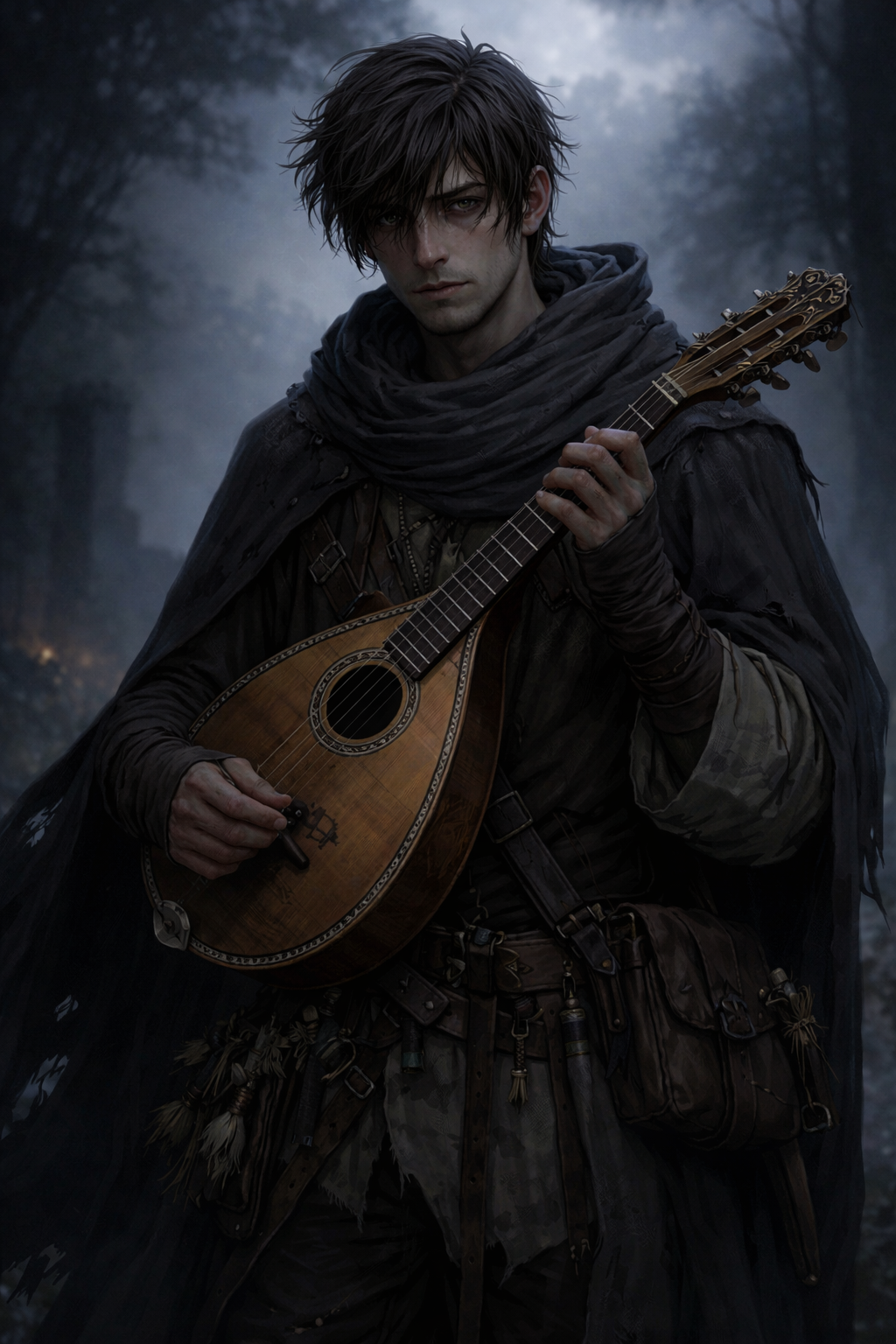
As Long as There Is Sound
The Last Winter of Varnhollow
Varnhollow did not reckon the passing of time by the turning of years, nor by calendars, nor by the patient mathematics of scholars who lived in cities far removed from frost and hunger. Time in Varnhollow was remembered by winters, each one carrying its own quiet story, and the people of that small settlement spoke of their lives not by numbers but by the cold that had accompanied them. They remembered the winter when the river hardened before its proper time and the fishing boats remained tied uselessly along the shore like animals forgotten by their masters. They remembered the winter when the grain stores dwindled to anxious handfuls and every loaf of bread was measured with careful hands and quieter prayers. But above all they remembered the winter when the sickness came, the winter that did not simply take lives but altered the very shape of silence within the village.
Aren Holt remembered these winters not as stories but as impressions that had settled into the bones of the people around him. The winter of his birth he knew only through the habits it had left behind. His mother never allowed the door to remain unlatched once the sun had fallen beyond the hills, even on evenings when the air was calm and the night promised nothing but frost and stars. His father developed the quiet ritual of checking the door twice before retiring to bed, not because he feared what might come through it, but because experience had taught him that carelessness was the most patient hunter of all. Within the household there existed an unspoken agreement that survival was not something to be celebrated loudly. It was acknowledged quietly, almost reluctantly, as though the world itself might overhear the gratitude and remember that it had overlooked someone.
The house in which Aren grew was modest in size yet deliberate in its arrangement, and though there was little within it that could be called luxury, nothing inside its walls lacked purpose. Each tool rested in its proper place upon the shelf. Each bowl returned to the same position upon the table after every meal. The order was not born from pride but from necessity, for in places like Varnhollow disorder had consequences that extended far beyond inconvenience. A misplaced tool wasted time. Wasted time wasted effort. And wasted effort, in the long arithmetic of winter, often became hunger. Even as a boy Aren learned to move carefully through the narrow rooms of the house, placing his feet lightly upon the wooden floorboards and closing doors with deliberate patience, as though the house itself possessed ears and might take offense at unnecessary noise.
It was during those early years that Aren began to understand the quiet language of sound. In Varnhollow, sound rarely existed without meaning. A cough carried with it the warning of illness. The sudden clatter of a dropped tool might announce injury before any voice had the chance to explain it. Even the rhythm of footsteps outside the door could betray whether the person approaching carried worry, anger, or exhaustion within them. Yet silence was something altogether different, something heavier than the absence of noise. True silence suggested that something had already happened and that the people present had not yet found the courage to speak of it.
For Aren Holt, it was not fear that shaped his childhood but attention, a careful and patient awareness of the world that slowly taught him that the smallest sounds often carried the greatest truths.
The viola entered his life in the same quiet manner that most important things do in places where survival leaves little room for ceremony. It rested against the far wall of the communal house, partly obscured by a stack of worn blankets and tools that had long since lost their original owners. The instrument appeared almost hesitant in its presence, as though uncertain whether it had been abandoned or simply forgotten. Its wood had darkened with age, polished smooth by the passing of many hands, and though the strings bore the dull fatigue of years they remained intact, stretched with the quiet resilience that only time can grant.
When Aren first lifted the instrument he was surprised by its weight. It felt heavier than its size suggested, as though the wood carried within it the memory of every sound it had ever produced and every moment of silence that had followed.
The first note he attempted to draw from it was not a pleasant one. The bow scraped across the strings with an uneven rasp that seemed to tear awkwardly through the still air of the room. The sound faltered almost immediately, collapsing into an embarrassed silence that caused Aren to instinctively flinch.
His father, seated nearby with a length of fishing line stretched between his hands, glanced up without haste.
“That is not a toy,” the man said calmly.
“I know,” Aren replied.
And still he continued.
He did not continue because he found pleasure in the sound. At that time the sound itself held little beauty for him. What held his attention was the moment that followed it, the subtle way the air of the room seemed to gather itself after the final vibration faded. There existed a fragile instant between sound and silence when the note had ceased but its presence had not yet fully departed. Aren began to listen for that moment with increasing patience, returning to it again and again until the space between sound and silence became more interesting to him than the music itself.
In the evenings, when the village settled beneath the weight of darkness and the quiet rhythm of sleeping houses, Aren would sit with the instrument across his knees and play softly. He did not play songs, nor did he attempt to imitate the melodies that older villagers sometimes hummed during festivals or long evenings by the fire. Instead he played intervals and single notes, allowing each sound to linger until it grew almost uncomfortable before releasing it into the waiting silence.
One night his mother found him still awake beside the fading warmth of the hearth. The room was dim, lit only by a stubborn glow of embers and the pale reflection of moonlight through the window.
“You should sleep,” she said gently.
“I will,” Aren answered, though his hands did not move from the instrument.
She watched him for a moment before asking the question that had quietly formed in her mind over many nights.
“Why do you play so late?”
Aren paused before answering, not out of uncertainty but because he wished to give the question the same careful attention he gave to every sound he studied. He turned the bow slowly between his fingers, considering the shape of the thought before allowing it to leave his lips.
“It helps the house breathe,” he said at last.
His mother did not ask him what he meant, and perhaps she understood more than she chose to say. She simply nodded once and left him to the quiet music, trusting that whatever the boy was listening for in the silence would find him eventually.
The Weeping Pox
The winter in which the Weeping Pox arrived did not at first distinguish itself from any other. The cold came early, as it often did, settling across the hills and creeping slowly into the narrow streets of Varnhollow. Frost gathered along the edges of rooftops and clung stubbornly to the frozen earth beneath the villagers’ boots. Smoke from hearth fires rose in thin grey columns toward a sky that remained stubbornly pale throughout the short daylight hours. Life continued with the same cautious rhythm it had always followed. Nets were repaired. Wood was cut. Bread was divided carefully across the tables of small homes where people had long since learned that preparation was the only kindness winter ever offered.
At first the illness seemed little more than an irritation, the sort of passing affliction that villages learned to endure without ceremony. People complained of soreness behind the eyes and a strange unwillingness of their tears to cease once they had begun. The first few who fell ill were treated with the same weary patience reserved for ordinary fevers. Someone joked that perhaps Varnhollow had finally found something worth crying about. The remark passed quietly among the villagers with the dull humour that accompanies long familiarity with hardship.
The joke did not survive the week.
The sickness changed quickly, and when it changed it did so without mercy. The tears did not cease. Eyes reddened and swelled until vision became blurred and painful. Skin darkened in strange patterns that spread slowly across the face and throat like bruises beneath the flesh. Fever followed soon after, fierce and unrelenting, leaving those afflicted trembling beneath blankets that could not hold warmth. Within days the quiet routines of the village began to unravel, replaced by the restless movement of frightened families and the low murmuring voices of neighbours who no longer pretended not to hear what was happening in the next house.
Aren fell ill before the village fully understood the shape of the danger that had entered it. One morning he woke with a dull pressure behind his eyes, as though the world had placed its weight gently but firmly upon his skull during the night. His vision blurred almost immediately, the room around him dissolving behind a thin veil of tears that refused to stop flowing no matter how often he wiped his face. His body felt heavier than it had the night before, every movement demanding effort that seemed unreasonable for such simple tasks as sitting upright or lifting his hands.
He tried to hide the pain at first, though even in childhood Aren possessed the quiet understanding that illness carried consequences not only for the body but for those who had to watch it unfold. Yet the fever rose quickly, and with it came a dull ache that spread through his limbs and settled heavily within his chest.
“It hurts,” he said once, the words slipping from him before he had the chance to swallow them.
His mother did not ask where the pain was, nor how severe it might be. She simply sat beside him and wiped the tears from his face with a cloth that soon became damp again no matter how often she wrung it out.
“I know,” she said softly.
The healer arrived later that afternoon, summoned from a neighbouring settlement where sickness had begun to appear in smaller numbers. She was a woman with tired eyes and hands that bore the marks of long practice rather than ornament. There were no symbols hanging from her neck, no charms or talismans that suggested divine protection. She carried only a satchel filled with herbs and instruments whose usefulness depended less upon faith than upon stubborn experience.
She examined Aren with the same quiet attention she gave every patient, listening to his breathing, observing the colour of his skin, pressing careful fingers against the pulse beneath his wrist.
“I can try,” she said at last.
No promises followed.
The treatment that came afterward was harsh in ways Aren would only remember later through fragments of sensation. Bitter herbs burned their way down his throat and left a lingering taste that no water could fully wash away. Blood was taken from him in small measured amounts while the healer watched closely for changes in the colour and thickness of what flowed from the wound. Words were spoken as well, though they were spoken with the careful tone of someone repeating old knowledge rather than invoking miracles.
Aren drifted in and out of awareness as the fever tightened its grip upon him. The hours stretched strangely, folding together until day and night became indistinguishable. Pain remained, though it blurred into something distant and unreal.
What he remembered most clearly was sound.
The slow rhythm of breathing from those who kept watch beside his bed. The quiet shuffle of footsteps across the floorboards. The occasional murmur of voices attempting to speak softly enough not to disturb him.
And somewhere within that dim haze of fever and drifting consciousness he heard the faint trembling notes of a viola being played somewhere in the house.
He never knew who had taken the instrument.
The sound reached him only briefly, like a fragile thread drawn through the fog of his illness, and yet it lingered in his memory long after the fever had finally broken.
Aren survived the sickness.
Many others did not.
When he finally woke fully, the world felt changed in a way he could not immediately describe. The air seemed quieter than before, though the village had not grown any less crowded with voices. Something within him felt hollowed, as though the sickness had passed through his body and taken a small piece of him away with it.
When he attempted to cry, the tears came slowly.
Reluctantly.
His father stood beside the bed, his expression carefully neutral in the way men often learned to keep their relief from appearing too openly.
“You are still here,” the man said.
Aren nodded.
“Yes.”
The word felt heavier than any he had spoken before.
Staying When Others Leave
When the worst of the sickness had finally passed and the long winter began, reluctantly, to loosen its grip upon the valley, the healers who had come to Varnhollow began to depart much in the same quiet manner in which they had arrived. Some left before the frost had fully lifted from the ground, their carts creaking softly along the narrow road that wound through the hills toward larger settlements where their knowledge might be more richly rewarded. Others lingered only long enough to accept the small payments that could be gathered from families who had already given more than they could afford. No one spoke harshly of them as they left, for the people of Varnhollow understood too well that survival often demanded movement, and that remaining in a place touched too deeply by death could slowly hollow a person in ways no medicine could mend.
In time the village returned to its familiar rhythms, though those rhythms were quieter than before and marked by the absence of voices that had once filled the narrow streets. Doors that had once opened easily remained closed. Chairs at kitchen tables remained empty. The ordinary sounds of daily life returned gradually, but they carried with them a weight that had not existed before the sickness came. Every laugh was softer, every conversation more deliberate, as though the village itself had learned that noise could attract the attention of misfortune.
Aren remained.
No one asked him to stay, and no one spoke openly about the role he had begun to occupy within the village. It happened slowly, as many lasting things do, without decision or announcement. People began to call for him in the night when illness stirred again within their homes, or when breathing became difficult and the quiet fear of losing someone settled over the household like a gathering storm. At first he arrived only to observe, carrying with him the fragments of knowledge the healer had left behind and the quiet patience he had learned during his own illness. He would sit beside the bed of the afflicted and listen carefully to the rhythm of their breathing, sometimes for hours, saying very little and offering only the small reassurances that could be spoken honestly.
Over time he learned to recognise subtle changes in the body that others missed. He learned the difference between a cough that belonged to exhaustion and one that belonged to something deeper. He learned the faint shift in breathing that occurred when the body struggled to continue its work. These things were not taught to him through instruction but through repetition and attention, the same quiet attention that had once guided his fingers across the strings of the viola.
Often the families asked him to speak, as though words might hold some power against the approaching darkness, yet Aren rarely found many that felt honest enough to offer. Instead he listened, and when the silence within the room grew too heavy for those present to bear, he would sometimes take up the viola and play softly. The sound did not drive away the sickness, nor did it restore strength to the failing body of the person lying in the bed, but it did something else that proved no less valuable. It reminded the room that life still moved within its walls.
There were nights when the music was the only thing preventing the silence from becoming unbearable.
It was during one of those nights that Elda came to him.
She arrived at the door of his family’s house long after the village had settled into uneasy sleep. The cold had returned briefly that week, covering the road with a thin layer of frost that crunched quietly beneath her boots as she approached. When Aren opened the door he saw immediately that she had not come for conversation. Her face was pale with exhaustion, and the red in her eyes suggested that sleep had avoided her for many nights.
“My children,” she said simply.
He did not ask which one.
When he entered the small house where she lived he found both of them lying beneath blankets that had been drawn too tightly across their thin bodies. The sickness had returned in them both, though it had taken a different form this time, settling deep within their chests and making each breath a difficult effort. Their skin carried the dull heat of fever, and the quiet wheeze that accompanied every inhalation told him more than any words could.
There was medicine left, but not enough.
Elda understood this as quickly as he did.
She did not plead. She did not raise her voice. She simply stood beside the bed and watched him with the tired steadiness of a mother who had already spent every tear she possessed.
The room was quiet enough that Aren could hear the slow creaking of the wooden beams above them. His hand tightened slightly around the small pouch that held the remaining measure of medicine. He knew exactly what it could do, and more importantly what it could not.
The bow slipped from his hand and struck the floor with a sharp sound that seemed far too loud for such a small room.
“I cannot,” he began.
But the words faded before they could reach their conclusion.
The choice had already been made the moment he saw the children lying beside one another.
Later, after the fever had taken one of them and the other slept uneasily beside the dim glow of the hearth, Aren remained seated at the table long after Elda had withdrawn into the other room. The house was quiet now, though not with the ordinary quiet of night. This was the quiet that follows loss, when even the walls seem uncertain how to hold the absence that has entered them.
He lifted the viola slowly and turned it in his hands, studying the smooth curve of the wood as though seeing it for the first time.
Then he took a small knife and carved a name into the inside of the instrument where no one else would see it.
His hands trembled slightly as he worked.
When the name was finished he rested the blade upon the table and whispered into the still air.
“I am sorry.”
From that night forward he carried the instrument with him wherever he went.
And from that night forward he spoke even less than before.
The Moment the Village Let Go
The years that followed passed with a quiet persistence that few in Varnhollow would later remember clearly, for they unfolded not as dramatic events but as the slow continuation of lives that had already endured too much to expect comfort from the future. The village remained what it had always been, a modest gathering of homes pressed between the hills and the long grey sky, where each day was shaped by work, weather, and the quiet understanding that survival demanded patience rather than ambition. Children grew older. Roofs were repaired when storms tore them loose. The river froze and thawed with the same indifferent rhythm it had followed long before any of the current villagers had been born. Yet beneath that familiar surface something had shifted, something subtle but undeniable, and though no one spoke of it openly, the presence of Aren Holt within the village had slowly become one of the quiet pillars upon which the fragile balance of Varnhollow rested.
He had never asked for such a role, and no one had formally given it to him. There were no ceremonies to mark the passing of responsibility, no spoken agreements declaring what he was meant to be. Yet the villagers had begun, without discussion, to turn toward him when illness visited their homes or when the fragile thread between life and death began to fray in ways they did not know how to mend. They called for him not because they believed he could perform miracles, but because he did something far more difficult and far more necessary. He stayed. When fear entered a house and refused to leave, Aren remained seated beside the bed until the night passed. When breathing became shallow and uncertain, he listened carefully to the rhythm of each breath as though the body itself were attempting to tell him what it required. When silence grew so heavy that those present could scarcely bear it, he lifted the viola and allowed a quiet note to fill the room, reminding those gathered there that the world had not yet ended.
He never claimed to be a healer, though he had learned enough of medicine to recognise the signs that mattered. Nor did he pretend to offer comfort that he could not honestly give. The people of Varnhollow gradually came to understand that what he offered them was not salvation but time. Time to speak the words that had been waiting unspoken between family members. Time to sit quietly beside a loved one and hold their hand without the urgency that panic often brought. Time to understand that even when life was slipping away, presence itself could still be a form of kindness.
In this way the years passed, and Aren grew into a shape that the village had never named yet quietly relied upon.
One morning, after a night that had stretched longer than most, he returned to his family’s house while the sky was still pale with early light. The road was quiet beneath his boots, the frost that lingered upon the ground crackling softly with each step. He had spent the night beside an old fisherman whose breathing had gradually slowed until the final breath slipped away with a calmness that surprised even those who had expected it. When Aren left the house, the family had already begun preparing the room for the rituals that followed death in small villages, and his presence was no longer required.
When he opened the door to his own home he found his mother seated at the table, her hands folded patiently before her as though she had been waiting there for some time. The quiet warmth of the hearth filled the room with a gentle glow that contrasted strangely with the grey light outside.
“They were asking for you again,” she said.
Her voice carried no accusation, only the quiet acknowledgement of something that had become familiar.
Aren removed his coat slowly and placed it upon the chair before answering.
“I know.”
She watched him for a moment before continuing.
“Not one house,” she said. “Everyone.”
The word lingered in the room with a weight that neither of them attempted to dismiss. Aren understood what she meant without requiring further explanation. The village had begun to rely upon him in ways that could not continue forever. Each illness, each death, each moment of fear that found its way into a household seemed to draw him further away from the life he had once lived. What had begun as simple attention had become expectation, and expectation was a burden that no single person could carry indefinitely.
He lowered himself slowly into the chair across from her and allowed the silence to settle between them before speaking.
“I cannot,” he said at last.
His mother nodded once, as though she had already expected the answer.
That evening Aren walked to the communal house where the viola had first found its way into his hands years before. The room was empty when he arrived, though the fading light of sunset filtered through the small windows and cast long shadows across the wooden floor. He sat quietly for a time, holding the instrument without playing it, allowing his thoughts to settle into something resembling calm.
When he finally began to play, the sound was soft but steady. The notes were long and patient, separated by pauses that allowed the room to breathe between them. He did not play a song that anyone would recognise, nor did he attempt to shape the music into something that resembled a performance. The sound existed simply because he allowed it to exist.
People began to gather slowly.
No one had called them. No announcement had been made.
Yet the villagers arrived one by one, stepping quietly into the communal house and standing along the walls or sitting upon the benches that lined the room. They did not interrupt the music, nor did they ask why Aren had chosen that evening to play.
They simply listened.
When the final note faded and the silence returned, it did not feel empty.
Aren rested the bow across the strings and looked toward the people gathered before him.
“I cannot stay,” he said quietly.
No one argued.
They understood, perhaps better than he had expected, that what he had become in Varnhollow could not remain confined within its narrow streets forever.
That night he packed the few belongings he possessed. The task required little time, for he had never gathered more than what he needed to carry easily upon the road. The viola rested carefully within its worn case, its hidden carvings pressed safely within the wood where only he knew they existed.
When he stepped toward the door his mother was already standing there, watching him with the same patient calm that had accompanied him throughout his life.
“Will you be safe?” she asked.
Aren considered the question carefully.
“No,” he answered.
For a moment she said nothing, then a faint smile touched the corners of her mouth.
“Good,” she said. “That means you will pay attention.”
Leaving
Aren Holt left Varnhollow before the sun had risen above the hills, departing in that quiet hour when the village still rested between night and morning and the world itself seemed reluctant to move. The air carried the faint sharpness of frost, and a low fog drifted slowly across the narrow road that wound between the scattered houses, softening the outlines of rooftops and fences until the entire settlement appeared almost dreamlike, as though it were already withdrawing into memory before he had taken more than a few steps away from it. The silence of that early hour suited him, for Varnhollow had never been a place that required farewell speeches or long embraces at the edge of the road. Its people understood that departure was simply another form of survival, and those who remained behind did so with the quiet dignity of those who had learned that holding on too tightly often caused more pain than letting go.
He walked slowly at first, not because he hesitated, but because he allowed himself the patience to notice the small details of the place that had shaped him. The narrow path between the houses bore the familiar impressions of boots that had passed over it countless times during long winters and uncertain harvests. The fence beside the communal house leaned slightly where a storm years earlier had loosened the posts and no one had yet found the time to repair them. A thin ribbon of smoke rose from a chimney near the far edge of the village where someone had risen early to prepare bread for the morning meal. These were not grand sights, nor were they things that would ever appear in stories told beyond the hills, yet to Aren they carried the quiet weight of belonging.
He did not look back.
It was not because he wished to sever himself from the place that had raised him, nor because the memories contained there were painful enough to avoid. On the contrary, he understood with a clarity that surprised even himself that Varnhollow had already settled permanently within him. It lived in the careful attention he gave to every sound that reached his ears, in the patient way he observed the breathing of those who lay ill, and in the small carvings hidden within the wood of the viola that he now carried upon his back. Turning to look at the village would not change any of those things. Varnhollow had already become part of him in ways that distance could never undo.
The road that stretched beyond the village wound gradually downward through the hills, passing between low fields that lay dormant beneath the lingering frost. The fog thickened for a time, swallowing the distant shapes of trees and stone walls until the world seemed reduced to the narrow space immediately before him. Aren continued forward with steady steps, listening to the quiet rhythm of his own breathing and the soft crunch of gravel beneath his boots. There was a strange calm in that moment, a feeling not of freedom but of recognition, as though he had reached a point that had been waiting patiently for him long before he understood it himself.
After a time he removed the viola from its case and held it gently against his shoulder. The wood felt familiar beneath his fingers, its surface warmed slightly by the pressure of his hands. He drew the bow slowly across the strings and allowed a single note to emerge into the pale morning air.
The sound was quiet, yet clear enough to travel beyond the road and into the empty fields that surrounded him. It did not resemble a melody, nor did it attempt to become one. It was simply a tone, steady and deliberate, sustained long enough for the air itself to acknowledge it before it faded.
Aren continued walking as he played, allowing the note to rise and fall in long intervals that matched the rhythm of his steps. Each sound lingered briefly before dissolving into the stillness of the fog, leaving behind that familiar moment of suspended quiet which he had learned to recognise since childhood. In that fragile space between sound and silence he felt something that resembled certainty, though it was not the certainty of purpose or destiny that others often spoke about with such confidence. It was a simpler understanding, one that required neither belief nor explanation.
As long as there was sound, he would remain.
As long as breath continued to move through his lungs and the bow continued to draw life from the strings, there would be something in the world that resisted the final silence that waited for all things.
The road stretched onward, disappearing gradually into the pale distance where the fog began to thin and the faint light of dawn touched the tops of the hills. Whatever lay beyond that horizon was unknown to him, and perhaps it would remain so for many years. Yet Aren did not hurry, nor did he slow his pace, for the future had never been something he believed could be forced into shape by intention alone.
He simply continued forward.
And behind him, though the village could no longer be seen through the fog, the faint echo of a single note lingered briefly in the cold morning air before fading into silence.
While the Road Still Holds
Yorvaskr had never been intended as a destination, and few who arrived there ever carried the illusion that it might become one. The town existed in that peculiar state shared by many settlements along the great roads of Yaskeilor, places built not from vision or ambition but from necessity, shaped by the needs of travellers who required shelter between journeys and by merchants whose caravans could not cross the entire continent without pauses along the way. Its streets were wide enough to allow wagons to turn without difficulty, its inns numerous and plain, their wooden signs creaking in the wind above doors that opened and closed with quiet regularity. The houses of Yorvaskr bore the marks of constant repair rather than thoughtful design, patched roofs leaning against weathered walls, additions constructed whenever need demanded them and abandoned when they no longer served their purpose. People arrived there carrying stories already worn thin by the road, and when they left they carried little more than they had brought with them. The town itself asked nothing of those who passed through it. It did not concern itself with origins, nor did it trouble itself with remembering names. Faces blurred quickly within its memory, fading as naturally as footprints along the muddy roads that threaded between its buildings.
When Aren Holt reached Yorvaskr he did so with intentions no different from those of countless travellers before him. He had already walked several days since leaving Varnhollow behind, the distant mountains slowly shrinking into a jagged silhouette against the eastern horizon until they existed more as a weight within his bones than as something he could still see with his eyes. The road had carried him steadily away from the village without demanding reflection, and he had not once turned his head to look behind him. There had been no reason to do so. Varnhollow had ceased to be merely a place the moment he stepped beyond its final houses, and what remained of it travelled quietly with him in ways that distance could not diminish. It lingered in the careful attention he paid to every sound around him, in the patience with which he watched the breathing of strangers when illness forced them toward uncertain nights, and most of all in the hidden carvings etched within the inner wood of the viola he carried across his back, each name preserved in silence where no one else would ever see them.
At first the funerals came quietly.
The first was little more than circumstance. A caravan guard had fallen ill on the northern road, his strength failing long before his companions reached the safety of the town. By the time they carried him into the tavern his breath had already grown shallow and uncertain, and when the final moment arrived the men who travelled with him discovered that none of them possessed the knowledge required to honour a life that had ended so far from home. Someone within the tavern mentioned that a traveller in town played music for the dead. No one remembered who had first spoken the words, but the rumour reached Aren before the evening had fully passed.
He went without hesitation.
The second funeral followed two days later, and the third soon after that. Death rarely travelled alone in towns like Yorvaskr where strangers gathered from distant regions and carried with them illnesses, exhaustion, and the quiet dangers that accompanied life upon the road. A dockworker died beneath the sudden shift of a cargo crate along the lakeside platform, the heavy wood collapsing without warning while the man beneath it had scarcely time to cry out. A beastkin woman arrived from the western passes only to discover that the winter storms had already closed the mountain paths she needed to return home, and by the time the town’s healer reached her bedside the cold had already claimed more strength than her body could spare. Each burial followed the same pattern. Names spoken softly by people who had known the dead for too short a time to speak with certainty, shallow graves cut into earth that had only begun to thaw near the lake’s edge, and the quiet presence of a musician who asked no questions and offered no promises.
By the end of the week the people of Yorvaskr recognised him, though few could have spoken his name if asked.
They knew only that when someone died and the silence which followed felt too heavy to bear alone, the quiet traveller with the worn viola would appear.
The burial ground lay just beyond the southern edge of town where the earth sloped gently downward toward the lake. The water stretched outward in a wide grey surface that reflected little beneath the winter sky, its stillness broken only occasionally by the slow movement of distant waterfowl that drifted across it like shadows. The soil there was softer than the hard ground of the northern hills where Aren had been raised, yet it carried the same cold weight that seemed to linger in all places touched by death.
On that morning the body awaiting burial had been wrapped in a travel cloak patched in several places, the sort of garment worn by someone who had walked too many roads to keep count of them. The cloth was worn thin along the edges, the careful repairs suggesting a life spent continuing forward rather than returning home.
Aren stood at the head of the grave as the small gathering assembled around it.
They were strangers to one another, united only by the quiet understanding that death demanded witnesses even when blood ties were absent. Most were human travellers whose paths had briefly crossed that of the deceased. A dwarf stood near the back of the group with his helm removed and held against his chest in a gesture of quiet respect, while two gnomes whispered uncertainly to one another as though they had not yet decided whether they belonged among those who mourned. A beastkin child clung silently to their mother’s sleeve, wide eyes fixed upon the grave with the stillness of someone witnessing a moment too large to comprehend.
No one spoke to Aren.
They did not need to.
He lowered himself slowly to one knee and settled the viola against his leg, the familiar weight of the instrument resting comfortably against his body. The wood had travelled with him from Varnhollow across narrow mountain paths and frozen roads, absorbing the cold of countless winters until it felt less like an object and more like a living extension of his own hands. He did not warm his fingers before touching the strings. The music he played in such moments required no preparation.
These were not songs intended to soothe the living.
They were rites.
The first note emerged low and spare, little more than a quiet vibration carried into the cold air between those gathered around the grave. It did not rise loudly nor attempt to command attention, yet it settled naturally into the silence that surrounded it. Aren followed it with another tone and then another, allowing the notes to fall into a pattern that repeated with deliberate patience. The rhythm moved slowly, matching the steady pace of breath so that anyone listening might follow its movement without effort.
This was how he played the Last Rites.
Not to guide the dead toward distant shores.
Not to promise peace where none could be guaranteed.
Only to acknowledge that a life had once occupied space within the world, and that its passing deserved to be marked before silence reclaimed the place it had left behind.
The music did not swell or fade dramatically as many funeral songs attempted to do. Instead it circled gently through a series of returning tones, each note leaving behind a brief echo before giving way to the next. The effect was subtle yet unmistakable. Those gathered around the grave found themselves breathing more slowly, their attention drawn not to the body resting beneath the cloth but to the quiet space between sounds.
The dwarf lowered his head.
One of the humans standing near the grave pressed their lips together as though afraid that drawing too deep a breath might disturb the fragile stillness that had begun to settle around them.
The beastkin woman resting beside her child closed her eyes and leaned gently against the small body pressed against her side.
Aren did not watch them.
He watched the silence that formed between the notes.
When the final vibration faded from the strings he allowed his fingers to remain where they rested, unmoving, and the silence that followed did not collapse into emptiness as silence so often did. Instead it remained suspended in the air, fragile yet balanced, like thin ice stretching across deep water.
The body was lowered slowly into the grave.
Earth followed.
The sound of soil striking cloth carried a dull finality that no music could soften.
No one applauded.
Those gathered lingered longer than necessity required before slowly dispersing, reluctant to be the first to leave the place where something had been properly acknowledged.
It was then that Aren felt it.
Not the ordinary sensation of eyes upon him, for that had long ceased to trouble him, but a more deliberate attention that seemed less like watching and more like study.
When he lifted his gaze he found the stranger standing apart from the others near the edge of the burial ground where grass gave way to scattered stone.
The figure was tall and narrow, his posture suggesting long travel rather than comfort. His skin carried a muted blue-grey hue through which faint veins could be seen beneath the surface like hairline cracks in weathered stone, marking him clearly as one whose lineage ran deep beneath the earth.
A gnome.
Older than most.
Ink stained the tips of his fingers, and a satchel hung at his side that appeared heavy with papers and small metal instruments that clinked softly whenever he shifted his weight.
He had not once looked away.
“You did not change the ending,” the stranger said.
Aren straightened slowly.
“No,” he replied.
Most who spoke after a funeral did so with gratitude or apology. This remark carried neither.
“They expect it to resolve,” the gnome continued quietly. “As though death were a story rather than a fact.”
Aren adjusted the strap of the viola across his shoulder.
“It is not,” he said.
The stranger nodded with quiet approval.
“That is why I stayed.”
Snow drifted slowly through the cold air between them.
“I have watched you before,” the man continued after a moment. “Not only today. Other graves. Other strangers. Places where people have already stopped asking questions.”
“I do not perform,” Aren said.
“I know,” the stranger replied gently. “That is precisely why I remained.”
From his satchel he withdrew a small metal token whose surface had been worn smooth through long use. A symbol had been etched into its face, though its meaning was not immediately clear.
“I belong to a society,” he said. “We call it a College, though that name suggests something more formal than what it truly is. We preserve memory. Songs, names, fragments of history that the world discards whenever survival becomes more urgent than remembrance.”
Aren said nothing.
“This is not an offer of greatness,” the stranger continued calmly. “Nor of belonging. Nor even of purpose.”
Aren studied the token in the man’s hand.
“Then what is it?”
“An invitation,” the gnome replied. “To travel where your kind of music is needed more often.”
“I do not believe in talent,” Aren said quietly.
The man’s hand did not waver.
“Neither do we,” he replied. “We believe in those who remain when others leave.”
Aren accepted the token. The metal was cold in his palm.
“Where?” he asked.
“The capital,” the stranger said. “High Hrothgard. Or anywhere between here and there. We do not require loyalty. Only honesty.”
Aren closed his fingers around the metal.
“I will come,” he said, “until I cannot.”
The stranger inclined his head.
“That is all anyone ever does.”
Then he turned and walked away across the frost-covered grass, leaving shallow footprints that quickly began to vanish beneath the falling snow.
Aren remained beside the grave for a long moment afterward. The token rested heavily within his pocket, while the viola leaned quietly against his chest as though waiting for the next sound.
At last he turned back toward the road.
Not toward ambition.
Not toward recognition.
Only toward a place where the sound he carried might matter to someone else.
While the road still held.
The Weight Between Places
The road that led away from Yorvaskr did not distinguish itself from any other road that crossed the wide and weathered lands of Yaskeilor. It did not rise into prominence, nor widen into a grand avenue that might suggest the beginning of something significant. Instead it continued with quiet indifference, pressed flat by the passage of wagons and countless boots, following the natural curves of the land as it traced the edge of the lake before turning gradually toward higher ground where frost and stone began to claim the earth. Aren Holt stepped upon it without ceremony, carrying little more than what he had brought into the town days earlier. His pack was light, its contents chosen with the deliberate restraint of someone accustomed to travelling long distances without the comfort of certainty. The viola rested against his chest, secured by a worn strap that had long ago moulded itself to the shape of his shoulder, and the familiar weight of it remained the only constant companion he required.
He did not depart at dawn.
He left when there was nothing left that required his presence.
Behind him the lake stretched wide and silent beneath a sky that refused to brighten, its surface reflecting the dull grey of winter clouds like a dark mirror that remembered too much of what had once stood before it. Aren did not turn to look upon it as he walked. Bodies of water possessed an unsettling habit of holding onto reflections long after those reflections had vanished, preserving them in quiet persistence as though memory itself were something that could become trapped upon the surface of the world. Roads, by contrast, possessed no such attachment. They accepted footsteps without judgment and forgot them with equal indifference, carrying each traveller forward without concern for where they had begun.
The first days passed without event.
Other travellers shared the road with him at irregular intervals, each moving with the quiet urgency that belonged to those who had learned that distance alone often determined survival. A pair of merchants travelling south crossed his path one afternoon, their wagon heavily laden with iron goods bound for the distant settlements of DragonRidge, the metal within their cargo clinking softly whenever the cart struck uneven ground. Later he encountered a lone hunter dragging a narrow sled behind him across the hardened earth, the heavy shape wrapped in animal hide suggesting the weight of a kill too large to carry upon the shoulder alone. On another morning he stepped aside to allow a small family to pass, the children walking silently beside their parents beneath cloaks that hung too large upon their narrow frames, their eyes fixed upon the distant horizon with the quiet determination of those who feared that acknowledging the cold might cause it to arrive sooner.
Conversations were brief when they occurred at all.
Some asked where he was heading.
Aren answered with the honesty that had always guided his speech.
North.
Few travellers asked further questions after hearing the word. The road itself explained enough.
When night arrived he rested wherever the land permitted it. Sometimes a small roadside shrine offered shelter from the wind, its weathered stone walls worn smooth by the passage of years and travellers who had paused there before him. At other times he found refuge within abandoned barns whose doors hung crooked upon rusted hinges, or beneath the lee of rock formations where the cutting edge of the wind dulled slightly against the stone. He rarely built a fire unless the cold demanded it with unmistakable authority. Heat possessed a way of drawing attention, and attention seldom proved beneficial upon the long roads between cities.
On certain nights others shared the same shelter.
Once it was a man whose lungs rattled with a broken cough that seemed determined to tear itself free from his chest, forcing him to sleep upright against the wall of a ruined chapel while his breathing settled into shallow rhythm before dawn arrived. On another evening a beastkin woman rested beside the embers of a dying fire, her hands trembling too violently to hold the knife that lay beside her, the blade dull from years of use that had slowly drained the strength required to wield it. There had even been a dwarf who spoke no words at all, who merely sat across the fire from Aren and listened quietly while a handful of notes from the viola drifted upward into the night air before disappearing among the dark branches overhead.
No one asked for songs.
What they sought instead was the simple presence of sound within the silence that surrounded them.
Aren obliged without comment.
He did not play each night. He played only when the silence began to grow too heavy within the small space they shared, when it threatened to fold inward upon those gathered rather than stretch outward into the darkness beyond. The notes he drew from the viola were spare and unadorned, shaped less like melodies than like the quiet marking of time itself. Each sound lingered briefly before fading into the cold air, leaving behind just enough structure for breath to find its rhythm again.
During those long hours he did not think of Varnhollow.
Instead he considered the strange weight that existed between places, the quiet suspension that belonged neither to departure nor to arrival but to the uncertain stretch of road that connected the two.
As he continued north the land began slowly to change beneath his feet. The soil grew harder with each passing mile, giving way to frost-bound stone that rang faintly beneath his boots. Villages became fewer and more distant from one another, their inhabitants cautious and watchful in ways that suggested a life shaped more by endurance than comfort. News travelled poorly across such regions where distance and weather disrupted every attempt at certainty, yet rumours possessed a remarkable ability to travel freely from voice to voice.
One name appeared often enough to become familiar.
High Hrothgar.
It was spoken with quiet respect by some and with careful caution by others, as though the place possessed a gravity that shaped the lives of those who lived beneath its influence without ever truly touching them.
Aren did not ask questions about it.
Cities had a way of revealing themselves only when one stood within them, and even then they rarely offered more than fragments of their true nature.
One afternoon near the edge of a narrow frozen pass he came upon a funeral already in progress. A small group stood gathered around a cairn of hastily stacked stones, their breath visible in the cold air as they shifted uncomfortably against the wind that swept down from the higher ridges. The dead man lay upon the ground beside them, wrapped in a heavy cloak whose hood had been drawn back to reveal a face pale and drawn from the cold. From the look of him he had been a caravaner, another traveller who had expected the road to carry him farther than it ultimately had.
They did not notice Aren at first.
He stood quietly at the edge of the gathering, uncertain whether his presence might intrude upon what little ritual the moment possessed. Then one of them saw the viola resting against his shoulder.
“You play,” the woman said.
Her words carried no question.
“Yes,” Aren answered.
They stepped aside.
The rite that followed was brief. The wind moved sharply across the pass, and the cold bit mercilessly at exposed skin. Aren kept the notes low and few, careful not to linger long enough for his fingers to stiffen beyond use. The sound did not travel far across the frozen stone, yet it did not need to. It existed long enough to mark the moment before the stones were placed over the body and the silence returned.
When it ended one of the men pressed a small bundle into Aren’s hands. Inside lay a strip of dried meat and a length of cloth that might serve as bandage or binding when the need arose.
There was nothing of value within it.
Aren accepted it anyway.
“You heading north?” the woman asked.
“Yes.”
She nodded once toward the cairn.
“So was he.”
There was nothing further that required saying.
When Aren continued along the road the small metal token given to him in Yorvaskr rested securely within the inner pocket of his coat, its presence a quiet weight against his chest. He did not remove it or examine the symbol engraved upon its surface. It was enough to know that it remained there.
He did not think of it as an invitation.
Instead he understood it as a direction.
High Hrothgar did not appear suddenly upon the horizon. The city revealed itself gradually, first through the faint shadow of distant walls rising above the land before the structures themselves became visible. The air changed subtly as he approached, sharpening with the scent of stone and distant smoke that drifted from countless hearths beyond the gates. The road beneath his feet grew more carefully maintained, its surface cleared of loose rock and its path marked by carved stones bearing symbols that reminded travellers they had entered a place shaped by deliberate design rather than accident.
When the outer reaches of the city finally came into view, Aren slowed his pace.
Not from awe.
From caution.
Cities gathered people the way lakes gathered water, drawing them inward with quiet inevitability, and what entered them rarely left unchanged.
That evening he rested beyond the reach of the city walls beneath a small stand of frost-bitten trees whose branches rattled softly in the wind. He did not play the viola that night. The silence that surrounded him felt balanced enough without assistance.
As he lay awake beneath the heavy sky he did not consider what awaited him within High Hrothgar.
Instead he thought of what he carried with him.
Sound.
Memory.
And the quiet understanding that sometimes the only thing a person could offer the world was the willingness to remain when others had already gone.
When morning came he rose without hesitation.
And walked toward the city.
A City That Remembers
High Hrothgar did not reveal itself to the traveller with sudden grandeur, nor did it rise abruptly from the land like the fortresses described in heroic tales. Instead the city emerged gradually from the horizon in the same patient manner that distant mountains announced their presence to those who walked toward them long enough. At first there was only the faint suggestion of something interrupting the natural line of the earth, a subtle distortion where stone and structure interrupted the rolling contours of the land. With each mile the shape grew clearer until the distant forms resolved into walls, terraces, and buildings whose presence seemed less accidental than deliberate. Even before Aren Holt could see the city in full, he felt the quiet pressure of it in the air ahead of him, as though the landscape itself had been shaped with careful intention rather than worn slowly into place by the careless persistence of time.
The final stretch of road climbed steadily toward the city, the ground beneath his boots growing harder with every step. The earth gradually gave way to laid stone, the surface pressed flat and maintained with an attention that suggested the path was travelled often enough to warrant care. Frost clung stubbornly within the cracks between the stones even where the pale winter sun touched the road, unwilling to surrender its hold upon the ground. Markers appeared with increasing frequency along the roadside, each set at measured intervals and carved with symbols whose edges remained sharp despite the passing seasons. They were not warnings meant to deter the traveller nor proclamations intended to impress the approaching stranger. They served instead as quiet directions, the kind placed by those who had long ago decided that the road itself mattered.
As the city finally came into view, Aren slowed his pace.
High Hrothgar did not attempt to dominate the land through height or spectacle. Its structures spread outward rather than upward, layered terraces of stone and timber reinforcing one another as they climbed the slope of the land. The walls surrounding the city were broad and practical, shaped to endure pressure and time rather than to inspire awe in those who stood before them. Smoke rose from countless chimneys throughout the settlement in thin disciplined lines that drifted slowly into a sky already heavy with cloud, carrying with them the faint scent of hearthfires and industry that lingered across the air.
The great gates of the city stood open.
A pair of guards watched the road from their posts beside the entrance, their attention measured and controlled in the quiet manner of men accustomed to observing travellers without interfering with them unnecessarily. Their eyes moved over Aren with the efficiency of habit, noting the heavy coat that shielded him from the cold, the modest pack resting upon his back, and the viola secured carefully across his chest. He carried no weapon, bore no crest, and displayed no sign of wealth that might draw suspicion.
They allowed him to pass without a word.
Within the walls the city breathed differently.
The sound of life moved through High Hrothgar with an order that distinguished it from the scattered noise of smaller settlements. Voices carried across the streets without becoming chaotic, conversations overlapping with one another in measured layers before dissolving naturally into the air. Footsteps struck the stone roads with a brief echo that vanished almost immediately, absorbed by the careful construction of the buildings surrounding them. Bells rang somewhere deeper within the city at quiet intervals, not summoning crowds nor announcing danger but merely marking the passage of time in a rhythm that belonged to the place itself.
Aren walked slowly through the streets.
He did not search immediately for shelter, nor did he approach anyone to ask for directions. Instead he allowed the city to unfold around him piece by piece, observing the patterns that revealed themselves within its movement. High Hrothgar bore the unmistakable weight of age, though not the kind of age that resulted in decay or neglect. Rather it possessed the layered appearance of a place that had been built upon itself across generations. Fresh stone reinforced ancient foundations. New beams of timber had been joined seamlessly with older structures whose surfaces bore the wear of many winters. Repairs were visible throughout the city, yet none were hidden or disguised.
This was not a place that pretended it had always been whole.
The people who moved through its streets carried themselves with quiet purpose. Messengers threaded through the crowds with satchels heavy with parchment and sealed documents, their steps quick yet precise as they navigated the busy avenues. Artisans worked within open-fronted shops where the tools of their trades lay arranged with careful order upon wooden tables, their movements efficient and economical. Even the moments of leisure that appeared among them seemed measured rather than indulgent, conversations shared between acquaintances spoken quietly and laughter restrained as though it existed within the boundaries of habit rather than spontaneity.
Aren noticed the musicians.
They were present within the city, yet their presence carried a restraint that unsettled him slightly. Near a small fountain a singer stood with her hands folded loosely before her, her voice rising with clear control through a melody that moved with careful precision rather than emotional abandon. Beneath a stone archway two string players performed together with disciplined harmony, their fingers moving with practiced confidence across their instruments while their expressions remained focused and composed.
The music here was not the release he had known in smaller villages.
It felt instead like record.
The distinction settled uneasily within his chest.
As he continued along one of the broader avenues leading toward the center of the city, the architecture grew heavier around him. Timber structures gradually gave way to buildings constructed primarily from stone, their doors reinforced with iron bands and their windows framed with carved supports that suggested permanence rather than convenience. Symbols appeared more frequently upon the walls and markers he passed, etched with deliberate care into the stone itself.
They were not religious.
Nor were they heraldic.
They depicted history.
Scenes carved into the stone showed moments rather than individuals. One panel portrayed a gathering of figures surrounding a long table upon which parchment lay unfurled. Another showed a crowd looking upward toward something unseen in the sky above them. A third depicted a solitary figure standing before a broken gate whose shattered beams lay scattered across the ground.
Aren slowed his pace as he studied them.
At the end of the avenue the road opened suddenly into a wide stone plaza whose surface had been worn smooth by generations of passage. At its center stood a low building constructed from pale stone, its façade plain except for the carvings etched carefully into its outer walls.
The College of Bards.
The structure did not dominate the square, nor did it attempt to draw attention through ornament or height. It existed with the quiet assurance of something that had no need to announce its significance to those who understood it.
Aren stopped at the edge of the plaza.
He did not approach the building.
Instead he sat upon the low stone base of a nearby column, resting his back against the cool surface while he adjusted the strap of the viola across his shoulder out of habit more than necessity. From that vantage he allowed his gaze to wander across the open space of the square while the life of the city continued around him.
People entered and left the College with quiet regularity.
Some approached the building with the ease of familiarity, exchanging brief nods with those they encountered at the doorway before disappearing inside. Others lingered at the edges of the plaza, hesitating as though uncertain whether they belonged within the walls they observed. Messengers passed through the square carrying their satchels of parchment, while a dwarf stood for several minutes beside one of the carved panels tracing the stone with thick reverent fingers.
Aren remained where he sat.
Time passed unnoticed.
Eventually someone noticed him.
The man approached with unhurried steps, his presence quiet and unobtrusive in a way that suggested long familiarity with the rhythms of the place. He was human and middle-aged, his dark hair threaded lightly with grey. His clothing was plain yet well kept, and faint stains of ink marked the fingers of his hands. His eyes paused briefly upon the viola before meeting Aren’s gaze.
“You are not playing,” the man observed.
Aren shook his head slightly.
“It is not needed.”
The man accepted the answer without further comment.
“You were expected,” he said after a moment.
Aren frowned faintly.
“By whom?”
The man’s expression softened into a small smile.
“By someone who listens.”
Silence settled comfortably between them while the movement of the city continued around the plaza without interruption.
“You do not look like most who arrive here,” the man continued. “Those who come usually carry ambition with them. Sometimes fear as well.”
“I arrived,” Aren replied quietly, “because the road ended here.”
The man nodded as though the explanation satisfied him.
“That happens.”
He gestured toward the entrance of the College.
“You may sit inside if you wish,” he said. “There is no requirement that you remain.”
Aren rose slowly and followed him.
Within the building the sounds of the city softened as though absorbed by the stone and timber that formed the walls. The interior was not silent, yet the noise that existed there carried a gentler quality that allowed individual voices and footsteps to remain distinct without becoming overwhelming. Shelves lined the walls of the corridors they passed through, filled not with instruments but with records of careful preservation. Scrolls rested beside bound volumes whose pages bore the weight of names written deliberately by hands that understood how easily memory could disappear.
“This is not a school,” the man explained as they walked.
“I know,” Aren replied.
The man glanced at him briefly.
“We do not teach talent here,” he continued. “What we preserve are the things that survive.”
They entered a small chamber illuminated by a narrow window through which pale winter light filtered across the floor. A wooden table stood at the center of the room with two simple chairs placed opposite one another.
The man gestured toward one of them.
“You will not be asked to perform,” he said. “Not for applause. Not for coin.”
Aren remained standing for a moment.
“I do not remain where I am required,” he said quietly.
The man inclined his head.
“Then you will not be required.”
Silence returned once more between them, familiar and untroubled.
“You will be tolerated here,” the man said at last. “You will be given space. Direction if you desire it. Work if it finds you.”
“And if I leave?” Aren asked.
“Then you leave,” the man replied simply. “But we will still remember that you were here.”
Aren considered the thought for a long moment before lowering himself slowly into the chair.
Outside the walls of the College the city continued to breathe with its steady rhythm of voices, footsteps, and distant bells.
Inside, the building waited.
Not expectant.
Not demanding.
Only present.
And for the first time since he had stepped beyond the roads of Varnhollow, Aren Holt felt no immediate need to rise and continue onward, not because he believed he had reached the end of his journey, but because within those quiet walls the simple act of staying did not yet require him to become something he was not.